


Money is a tool not a purpose. Overestimation of money leads to vulgarisation.
Are we “spending time” or are we “paying attention“?
It is a provocative question that makes us think about what an effective time management routine entails.
Nowadays, we understand almost everything about “time”.
We do not only understand what is the past, the present and the future.
A wise man once said:
I totally understand time, till the moment I need to explain it to somebody.
In other words, the scientific explanation of time still does not exist.
“The past” is our memory. “The future” is our intentions. “The present” is our perception.
So should we use an illusionary “time” concept as an element of actual business procedures?
Or should we better apply a more realistic category?
In ByCycle, we want to be functional and practical.
How it is possible to manage something, nobody understands anything about? And nobody knows if it even exists.
So, instead of “time”, we use attention.
Instead of “spending time”, we use paying attention.
A simple change of wording brings a massive shift in attitude and allows enormous improvement in daily performance.
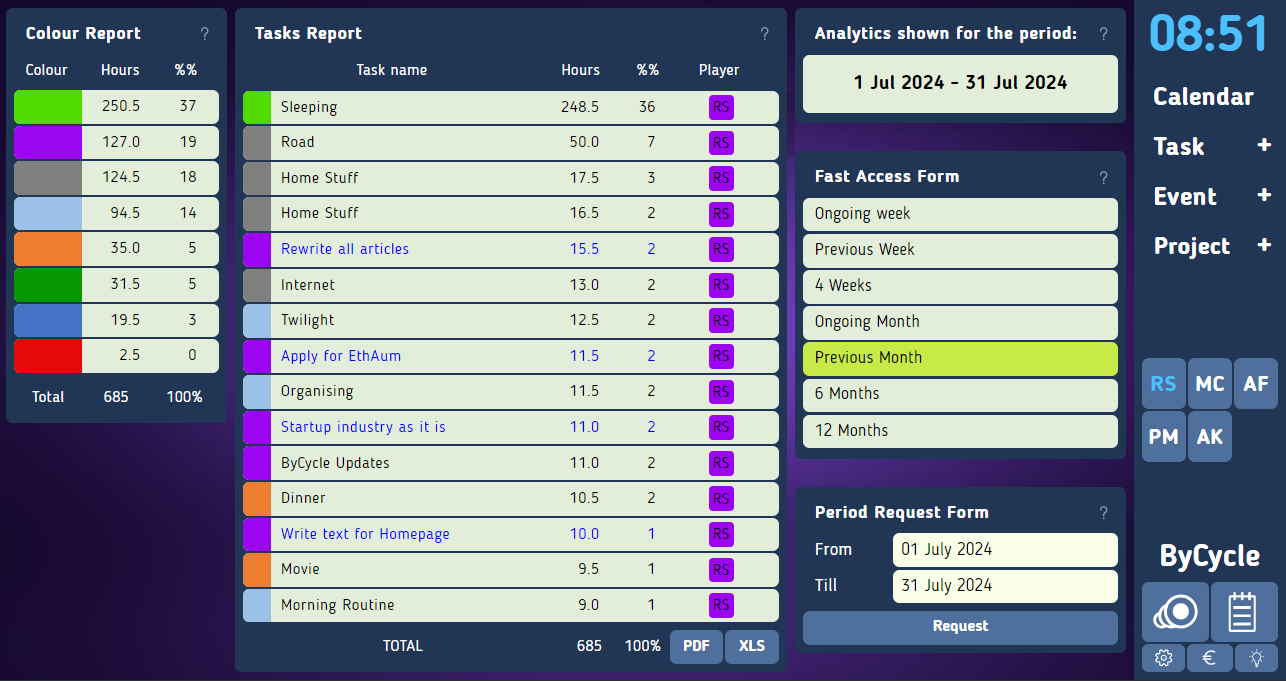
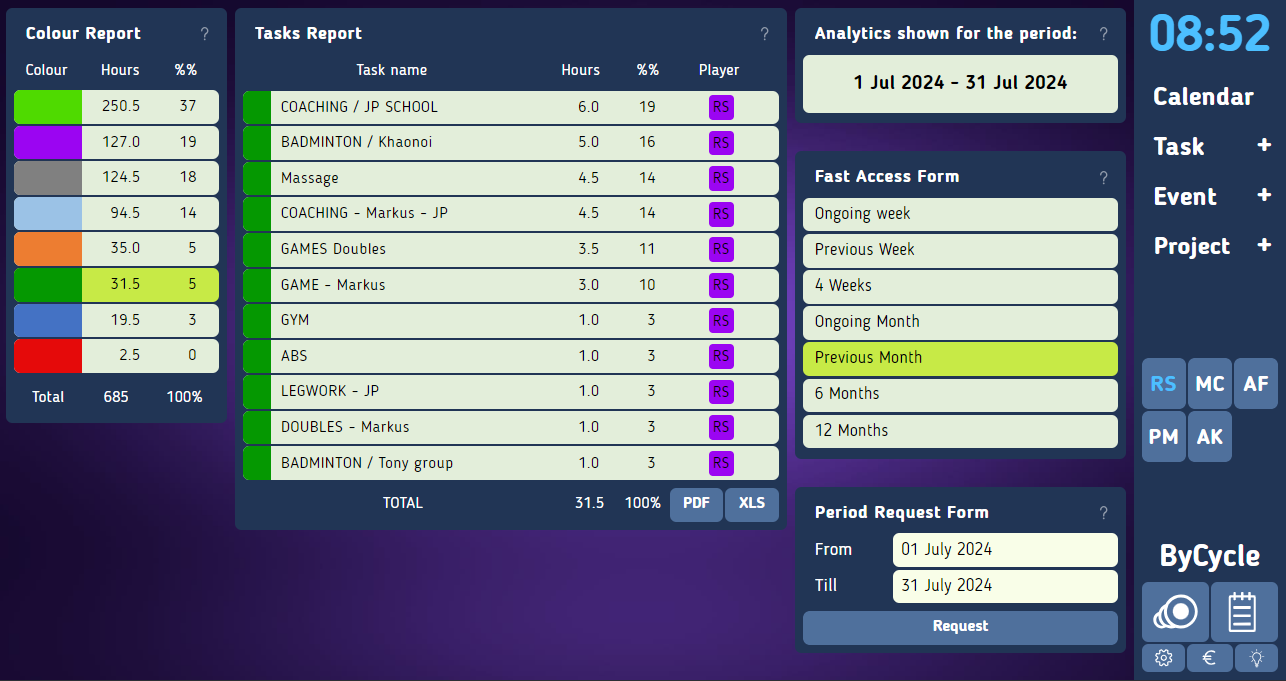
Attention Report is a mirror of our lives.
Time is cheap and belongs to nobody. But our attention is our precious asset. And we are totally able to control it.
Attention is our universal currency, which we started to use as a means of payment long before any fiat or crypto stuff.
Time is not money, our attention is.
We can burn our attention on some meaningless activities, which will never bring anything in return. Like scrolling short videos and news.
Or we can start investing our attention into life-changing events.
With ByCycle, we can pay attention to our activities and plans.
Which is a smart thing to do.
Nothing will happen in our lives, if we are paying so much attention to lives of other people.
Try ByCycle for free and see how it works for you.
Check our gallery for more pictures of ByCycle.
For any questions or comments, feel free to contact us here.
Money is a tool not a purpose. Overestimation of money leads to vulgarisation.

Your personal value tends to be negligible. Everything changes as only you become one of us.
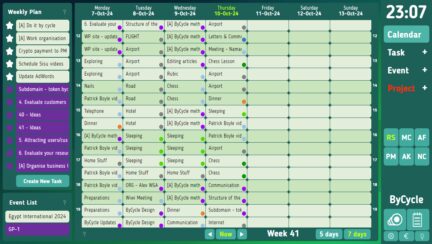
In this article we describe some basic practices to start working with ByCycle.

1st Challenge – Record your life
Increase value of your attention with this powerful self-organising routine.

In this video we show how to create a task directly from Calendar and how to add activities to this task.

Practical time management and breaking free from "I am busy" excuse, by Seyi Tosin.

We asked ChatGPT what does she think about the design of ByCycle. And here is what she answered.

Best tools for task management
The better we understand the key cycles of our lives, the more successful and capable we become.

The better we understand the key cycles of our lives, the more successful and capable we become.

Smart ways of work organisation
To stay organised, we record our activities, write down our ideas and work upon weekly plans.

It is not the question of how well organized we are. The question is how much disorder we allow in our lives.
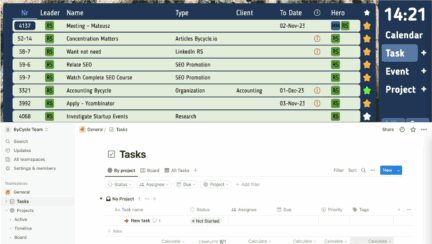
We often get a question: "How ByCycle is different?" Well, just look at these pictures.

The ability to keep a stable tempo defines how far you can reach. There are objective reasons why we procrastinate.

The inner engine is the key to business success. It determines our capacity to operate at the edge of our abilities and identifies the boundaries of such capacity.

When we think that we have plenty of free time, we should look around and check what is terribly wrong with our lives.

To handle psychological stress professional athletes keep saying: "Do what you can, with what you have, where you are".

Everything starts with a good sleep. The earlier we go to sleep the better chances to wake up early as well.
Have you ever wondered how much time do we have? Well, wonder no more. There is an exact number.