
How to start my own business?
In this article, we will delve into the major challenges of how to start your own business.
Who is an entrepreneur and why is it important. Why starting a company is not enough to become an entrepreneur?
What are 3 basic conditions to be met to start any business and why money is never the main issue.
How to become an entrepreneur.
Let’s imagine you have a business idea, and you believe you can build a sustainable company out of it. When should you start with your business?
Wrong approach of ignorant people.
The common wisdom of the startup industry is “to start as soon as possible”. Then inevitably fail, smile and move on with a new idea. Repeat this cycle on and on till you eventually succeed. Or not.
Obviously, it is a very wrong approach and nobody should act like that. Unless you have access to abundant and free money, which you can burn for nothing.
If you are a reasonable person, then failing should not be anywhere on your calendar or to-do list. You start a business to succeed, not to waste your attention and resources. Only ignorant and low-intelligent people could “advise” something like “fail, fail, fail till you succeed”.
Crucial skills for a true entrepreneur.
For the sake of business success, you should ask yourself if you already possess the qualities and skills of an entrepreneur.
The truth is simple:
To run a sustainable business, you should become a reliable entrepreneur first.
Yes, we are all born as free entrepreneurs. And we all possess the necessary abilities which allow us to start and run a business. Upon the condition that such abilities are developed enough.
We described some of them in our other posts. Let’s briefly observe them to see the main picture.
1. As an entrepreneur, you should have a natural desire or a drive for creativity and challenges. We call it the inner engine. Without inner engine, you will not be able to keep path with the business tempo. You cannot trick or suppress yourself into a focused everyday work. It only happens by your free will, and your inner engine is responsible for that.
2. Any business activity is a piece of work which should be understood, planned and done. The ability to create work is one of the key abilities of an entrepreneur. You think about your work, you plan it, you track the progress, you record your results. You are the main person to make things happen and to have the work done.
3. Nothing happens in this world without confidence. And confidence is impossible to achieve without being able to focus and concentrate. By focusing, we understand your ability of paying attention to stuff which matters for the final result and letting everything else go.
4. Unfortunately, doing business is not a walk in a park. It is more like building a railroad in front of a moving train. That’s a lot of stress you can imagine. Your ability to handle that stress defines the overall success of your venture.
5. Organize yourself, before you start organizing others. Meaning, that you cannot effectively coordinate people if you cannot coordinate your personal efforts. Efficiency is the key – you will always be restricted in resources in overwhelming conditions.
6. At your company, you are your main boss, mentor and supervisor. If you cannot rely on yourself and on yourself only, you will spend too much time waiting for other people’s assistance, which will never come. You are the one who will deal with confusing and desperate situations. You are the one to bear responsibility for your decisions. You are the one to have the work done.
To be successful with a business activity, you have to develop your entrepreneurial skills. Hopefully, now you understand why.
Basics of doing business.
After you sort out your strong and weak sides as an entrepreneur, you can move forward with your business idea.
If you have many ideas, forget about all of them except the one which is the easiest to do. Focus all your attention and energy onto this and this only idea – it will raise your chances for success.
To start with a commercial adventure, make yourself clear that you know three basic things:
1. You know how to produce value. Your product.
2. You know who is ready to pay for the value. Your customers.
3. You know the right way to inform your customers about your product. Your promotion channels.
These are the 3 pillars of your business success. You fail one of them – your entire venture will collapse in no time.
Let’s think logically and ask the right questions:
If you do not have any value to provide, then what do you expect to get paid for?
If there are no people ready to pay for your value, then where will your revenue come from?
If nobody knows about your value, then how could anybody find you?
That is why there is no business activity which could ignore these 3 basic things. One way or another, you have to answer all these questions. Moreover, you want to do it.
Let’s dive into each of them separately.
How to start a company.
You start with your value, of course.
Without detailed knowledge about value of your business, you cannot locate your customers, neither the right way to address them.
And by the value we mean something which can be exchanged for money. We do not mean the value of you as a person and individual.
Your first value is your skills.
The simplest value to proceed with is your present knowledge and skills. You know accounting – start an accounting business, you can do coding and programming – start an IT company, you can play badminton – become a coach and start a badminton school, you have an empty apartment in a good place – list it on booking.com. You understand the logic, right?
If it is your first business exercise, then keep it as simple as possible. Ideally, you should start it totally on your own. Or with a partner who possesses similar knowledge and skills. In this scenario, your commercial value is already there, you do not need to create it from scratch.
Another strong side of this approach is that it is the cheapest option to start with. You do not have to invest money in the development of a product or a service which might not be needed by prospective customers that much.
Work consists of tasks, projects and events.
After you determine the value, you clarify the amount of work to create such value. By work, we understand focused efforts to achieve specific results. All work can be divided into tasks, events or projects.
And this is exactly what you want to do – you want to have a clear picture of how your organization is working, which resources get involved, how you produce, how you deliver, how you keep books, how you hire & dismiss etc. The better understanding you have about the work involved, the better quality you can provide. Which is good for business.
So you take all the work around your business and divide it into tasks, projects and events. For tasks, particularly for recurrent ones, it is also useful to create a step-by-step description of the way to perform them. We call it algorithms.
This little action will considerably simplify the work on such tasks and bring better results.
Starting a company is not starting a business.
To finalize, we should mention such a step of business organization as starting a company. Let’s face the truth – formal establishment of a company has zero to no impact on the value itself, neither has it for bringing customers nor creating stable communication.
Starting a company is a legal requirement you have to comply with at some point, but you should never confuse it with starting a business itself.
How to determine your customers.
People who want your value to the point that they are ready to pay for it are your customers or clients. Without such people, you would not have any business.
Determining which people are your customers and why exactly they want your value, is something that a smart entrepreneur would do.
If you ignore this step, you put your business under serious risk. You might overlook some crucial details and lose yourself in a world of illusions. You will expect some style of behavior which in fact does not happen that often.
So how do you find out who is your regular customer – the one which wants your value on a regular basis, and therefore creates the core of your business organization.
Businesses and private people.
First, you clarify the nature of your customers. Are they other businesses, or customers, or both? Businesses and private people tend to spend money in a very different way and with a very different attitude.
If your main customers are other businesses, then businesses of which size and for which purpose they will use your value: resale, consumption or investment. It will considerably affect the purchase decisions of your customers.
In some cases, they will value the price, in some cases – quality and in some cases – customer support. So it is meaningless to describe to your prospects how high quality and rich functionality your product is, if the company owner cares only about price. And vice versa.
Similar logic works with private customers. Though in this case, the accessibility and convenience of a customer also play a great role. In other words, you should understand how you deliver to your customers: are they coming to your place or are you coming to theirs?
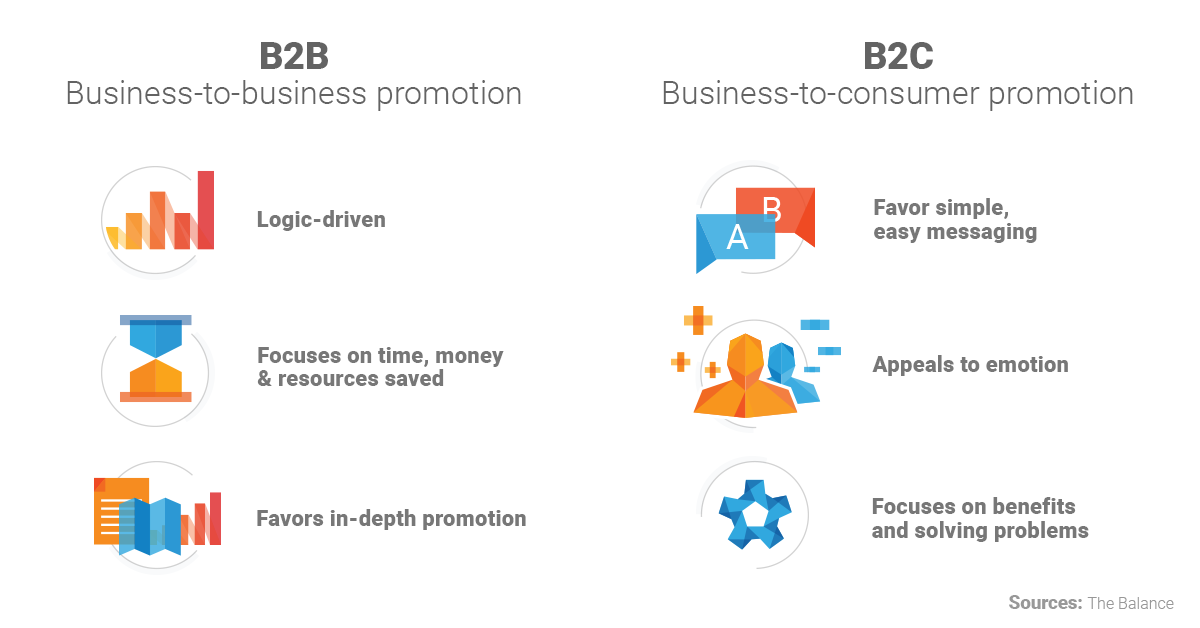
Business and private customers expect different approach.
Loyal customers buy more than random customers.
Another crucial point which you want to clarify is the loyalty of your customers. In other words, are your customers just random people, who come, buy and go forever. Or are you going to build a stable community of customers, which stay with you for a long time, buy repeatedly and whom you know personally.
It is obvious enough that your business model will work differently in both scenarios. With random people, you should invest in the first impression and be more intense with promotion.
With a long-lasting community, customization for specific needs of particular people and stable communication will play the biggest role.
All customers are people and all people are different.
It is rarely a case that a business has only one specific group of customers which all behave the same way. Normally, it is a mix of different groups with different needs and attitudes.
So it would be a good practice to create a written description of common groups of customers and record particularities in their behavior.
Of course, instead of recording, it is more simple just to remember. And from another perspective, it is more clever to record. In this case, you do not have to overload yourself with information, and you can make business decisions based on your customer’s profile.
How to build communication.
Even with delightful value and awesome customers, there is still one magic which needs to happen to make your business work.
Your value and your customers need to meet each other in the time-space to make a transaction happen.
Basics of sales.
In the classic business management science, this “magic” is normally called “sales” – the process of approaching prospects with an undeniable proposal of your value for a reasonable price.
And this is a wrong attitude.
The more pressure you inflict on your customers, the more resistance you will get in response.
Common wisdom says that it is much easier to sell something that people like and need, than something that they do not like and do not need.
We all like to buy, and we all do not like to be tricked or suppressed into buying. The final decision should be all ours, since we are spending our own money.
Communication means collecting and providing information.
That is why a smart entrepreneur does not develop sales. A smart entrepreneur develops stable communication.
There is a prospect; a company which might benefit from your value. And they are still not sure that this value could bring them something that they want. You can go a classic “sales funnel” or “sales pipe” way – push this prospect from one status to another till it eventually reaches the “invoice settled” phase. You may succeed or, most likely, you will not – at one point, this prospect will just “ghost” you and block your contacts.
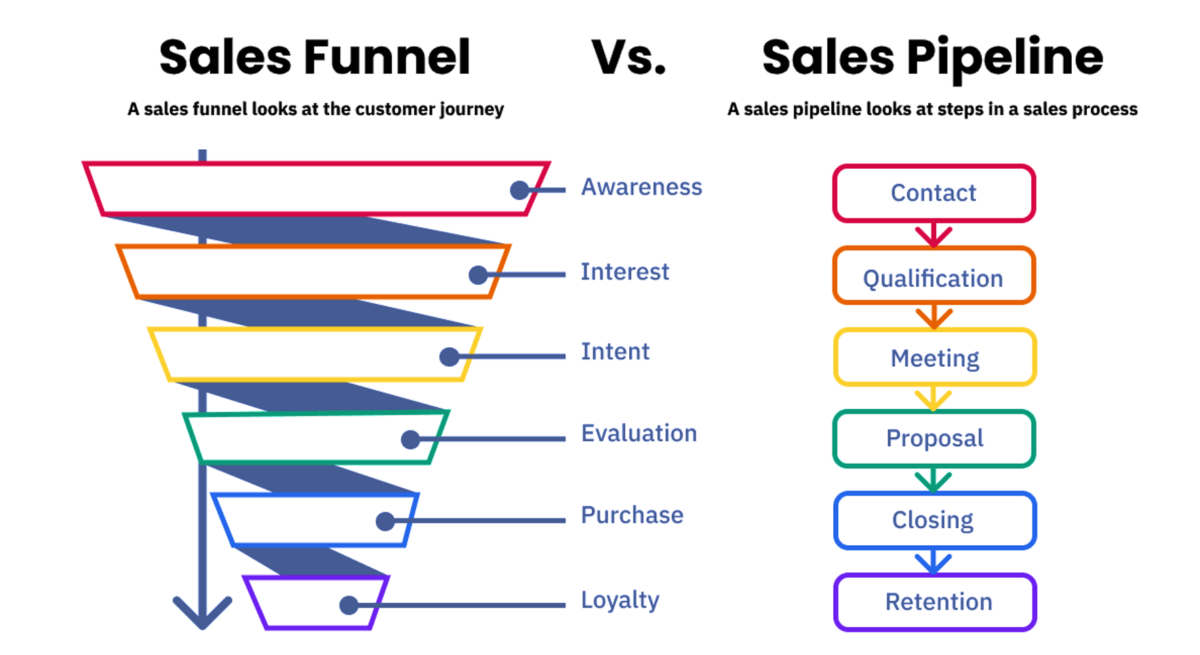
Sales Funnel & Sales Pipeline are common technics to lead the process of sales.
That is why, instead of pushing, you want to utilize the option of informing. You should consider your prospects to be smart and reasonable people, who can make their own decisions in the way which best suits their situation.
It is clear enough that understanding the current situation of your prospect’s business or life is much more important than how far you managed to push him/her through the “sales pipe” statuses.
In other words, the healthiest promotion model works in the way that you inform your potential customers about the value you produce, and then they make the decision to purchase your value if it fits their needs.
You do it by collecting and providing valuable information.
Chose promotion channels wisely.
The truth is that you can communicate with your customers in different ways. You can invest in ads or SEO, send direct messages, list your business on Google Map, make your business location look attractive, spam thousands of accounts with “tailored e-mails” and so on and so far.
At the beginning of your business journey, you never know which channel will work the best in respect of creating stable and meaningful communication. By meaningful we mean the one which leads to value exchange.
What you could do here is to think logically, to experiment, to check businesses which produce similar value, to ask people who have experience in your industry. One way or another, there should be a channel which will draw attention to your values and create opportunities for stable communication.
The smart thing to do is to create a table, where on the vertical line you have all types of your customers and on the horizontal line you have all available types of promotion channels. You take one specific category of customers with one specific promotion channel, and you exploit it for some period of time.
Then you evaluate the results and make a decision to proceed with the current selection or to try something else.
Examples from real life.
1. One entrepreneur decided to propose an apartment in the Old Town of Tallinn for short rent for tourists. He made some renovations and made announcements on the local real estate platform and Airbnb. During July-September (high season), he got 3 guests who stayed for 6 days in total (out of 92). Things changed after he listed his property on booking.com – even in the low season of October-November he got 60% days booked. Business existed for 4 more years with 85% of bookings coming from booking.com.
2. Another entrepreneur decided to start a legal company and, since she was a smart girl, she made the table of customers and promo-channels as described above. From all the options available, she decided to proceed with big legal companies and address them with a simple e-mail informing about her services and asking for a short meeting. She got enough responses to hold introduction meetings and eventually got requests for legal services. Further promotion happened by writing to the same database and from recommendations from satisfied customers. After a year of running the business, she opened the table again and decided to address agricultural companies with the same e-mail. She sent 400 e-mails and got exactly 0 responses.
3. One lady finished massage school, got her certificate and worked as a massage therapist for several years till she decided to open her own parlour. As the main promotion channel, she chose visual announcements placed on the property. Meaning that only people who were passing by her place could see the visuals and get informed about her services. She got 4-5 customers per day in a high season and 1-2 customers in a low season. Business was barely surviving, despite the fact that she provided high quality massage. Luckily enough, she got some assistance from an experienced entrepreneur, and together they settled an account at Google Map. That happened to be the right move, and now she gets 12-15 customers in a high season and 5-8 customers in a low season.
There is no way to overestimate the crucial importance of the right promotion channel for business success.
Your delightful value and your awesome customers can find each other only through correct and stable communication.
Money is never the issue.
It is difficult to overstate how common a statement is that money are the main reason for not starting a business. And it is difficult to overstate how false this statement is.
Business makes money, not spends it.
Foremost, let’s think about the nature and purpose of any business. No, it is not making as much money as possible, despite another widely spread misbelief. The idea of any business is to provide high quality products or services for a reasonable price.
As we already know, business is the process of exchanging values. You provide the value of your product or service and your customers provide you with the value of money in return. In this respect, each and every business works the very same way.
Meaning, that if your value fits with quality expectations, and it is reasonably priced, there will always be people willing to make a “money for value” transaction. So, you have a sustainable business model only if your business generates enough revenue to cover all costs plus reasonable income for its beneficiaries. Since in this case, there are enough people to pay for your value.
It is never a question about how much money your business can burn. It is always a question about how much money your business can earn.
What money can and what money cannot do for you.
Imagine you have One Million Money (OMM). It is a large amount of money to be honest. If we talk about decent currency, not about coloured paper. Is it enough to start a business?
Well. No.
One million dollars it is not something bad
We already know that each business stands on 3 pillars: value, customers, promotion channels. So let’s find out how money could help you here.
Value. Does OMM mean that you have a value that people are ready to pay for immediately? Of course not. Your value might need some investment to be commercially exchangeable. OMM does not produce value in your business activity. This value is produced by the creative and focused work of your team. Value is produced by skills, by technologies, by reliable people. OMM has nothing to do with that. You have OMM and you do not have skilled reliable teammates – you do not have value.
Your customers. Can OMM show you the people who are ready to start buying your value straight away? Unfortunately not. The reason is that at the start of your business you can barely imagine which people will actually become your clients. OMM can neither determine your customers nor affect their purchasing decisions. Surprisingly enough, skilled teammates can do that. In its turn, OMM can help you to hire a bunch of marketing experts, who would willingly help you to spend this OMM asap.
Your promotion channels. But for promotion of value, business demands money, you would say. Yes, that is true. Advertisement is the engine of commerce. Some research shows that the global advertising market size was valued at USD 667 Bln in 2022 and will reach USD 871 Bln in 2028. Still, would OMM help you to establish meaningful and stable communication – no. Would OMM help you to actually sell something – no. Would OMM help you find the correct promotion channel – no. This will all be achieved by your focused and consistent work.
Still, let’s not speak about OMM as if it is something bad. Some industries have a sort of entrance ticket to be paid for, before you even start a business. For example, in Estonia you have to establish a company with a charter capital of at least One Million Euro, to get licensed for fuel trade. Even if you want to open a small coffee-shop selling weed in Pattaya, Thailand, your starting investment would be estimated to be around THB 400K (~10K Euro).
In other words, the amount of money you possess determines the types of businesses you are able to proceed with. The bigger the amount is, the wider is your choice.
But money itself does not determine your current entrepreneurial skills and therefore your ability to start and run a business as such.
If I have no money at all.
If you have no money at all, it does not mean you do not possess any commercial value. It does not mean you do not know your customers. And it does not mean you are not able to build stable communication.
It only means that you are restricted in your business choices. Most likely, you should proceed with your personal knowledge and skills as your major value.
You do not have any knowledge or skills? Then you are not ready to start your business, since you have not completed your homework. Go to the labor market, earn your living, use your free attention to get some useful knowledge and skills. And by “useful knowledge and skills” we mean the ones which could be exchanged for the value of money.
As you can see, even in the case of a total lack of money, money itself is not the main obstacle for starting a business. Lack of knowledge and skills is.
Your value, your customers and your promotion channels are decisive factors in your business success.
Money can help you, money can spoil you, but money cannot do business for you.

One million dollars it is not something bad.
ByCycle.
Each activity is more simple and joyful when you use appropriate tools.
If you want to write a note, use a pen. If you want to drive a nail, use a hammer.
If you want to start and run a sustainable business, use ByCycle.
NB! Only the browser version is available. The mobile version is under development.